

“Do I need a new hip?”
Am I going to need a hip replacement??
This is something we hear ALL the time in clinic.
If you get pain in your hip or upper leg region.
If you feel discomfort when you’re out for a walk.
If you get stiff going from sitting to standing you might quickly jump to the conclusion that the only solution is to pop it out and chuck a new hip in there.
Sometimes, this is the inevitable outcome, however, the good news is that this is only the case in around 5% of the cases we see in clinic.
Most of the time, hips don’t need replaced.
Hip pain can come from lots of different sources. Sometimes it’s the hip joint itself, but more commonly the pain is being generated from the lower back, pelvis, muscles, tendons or even referred pain from further afield.
That’s why getting the right diagnosis is so important.
At CoreHealth Chiropractic, one of the first things we do is work out exactly where your pain is coming from before discussing the best treatment options for you specifically.
Why do hips wear out?
The hip is one of the hardest-working joints in the body. Every step you take places several times your body weight through the joint.
For many people, wear and tear develops gradually over many years.
Some of the common reasons include:
Age-related osteoarthritis
Previous sporting injuries or years of high-impact activities such as rugby or football
Previous fractures or trauma
Carrying a little more weight than you should be, which can increase the load through the joint
Another factor that often gets overlooked is the way that your body moves. Imagine driving your car with the wheel tracking slightly out of alignment. Over time one edge of certain tyres will wear much faster than the others due to this asymmetry.
Your hips work in a similar way.
If your pelvis isn’t moving well, your lower back is stiff or your knees and ankles aren’t working as they should, extra stress can be placed through one part of the hip joint over thousands of steps every day.
While we can’t say this causes arthritis on its own, abnormal movement patterns can certainly increase the load placed on an already vulnerable joint.
What does hip osteoarthritis actually look like?
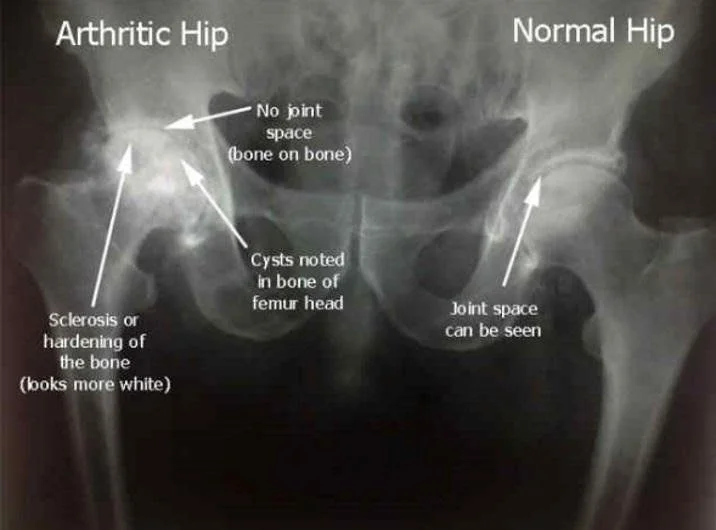
When we look at an x-ray of an Osteoarthritic hip, there are several things we look for:
Narrowing of the joint space, showing that the cartilage has worn away
Extra bone formation (called osteophytes or bone spurs)
Thickening and hardening of the bone beneath the cartilage
Changes in the shape of the joint over time
The reduction in joint space is often the easiest thing to spot. Healthy cartilage doesn’t show on an x-ray, so what we’re really seeing is the space between the bones. As cartilage wears away, that space becomes smaller until, in severe arthritis, the bones may almost touch. You might have heard someone share in the past that their hip was ‘bone on bone’.
However, it is important to remember that x-rays only tell part of the story.
Some people have significant arthritis show on an x-ray but very little pain, while others have relatively small changes yet experience considerable discomfort. That’s why we always assess the whole person, not just the picture.
Can chiropractic reverse arthritis?
This is another question I get asked a lot.
The honest answer is no, not in my experience.
Once the cartilage has worn away, we can’t really grow it back (although there are a lot of bright minds out there working on how to do this!).
However, this doesn’t mean there’s no help available…
Our goal is to help reduce the stress going through the hip by making sure the rest of your body is moving as well as possible around it. That may include improving alignment in your pelvic biomechanics, strengthening your core and improving flexibility in your musculature.
When these areas move better, many people find walking becomes easier, stiffness reduces and everyday activities become more comfortable.
Keeping you moving is one of the most important things we can do.
What if I do eventually need a hip replacement?
Sometimes, despite everyone’s best efforts, a hip joint becomes too worn and a hip replacement is the best option.
If that’s the case, please don’t think of it as the end of the road.
Modern hip replacements are often incredibly successful and help thousands of people return to active lives with reduced pain every year.
In fact, I’ve found that Chiropractic care plays an important role in preparing for surgery, and can make a real difference to your recovery.
Research shows that people who go into surgery stronger, more mobile and better educated about their rehabilitation often recover quicker AND regain function sooner than those who don’t prepare beforehand.
Before surgery, we can help by:
Keeping the joints above and below the hip moving as well as possible
Ensuring your nervous system is functioning optimally
Improving your overall mobility and flexibility
Offering advice on exercises and movement
Then, once your surgeon has confirmed you’re ready, chiropractic care can also play an important role afterwards.
Our focus at that stage becomes helping your body adapt to its new mechanics, improving movement through your spine and pelvis, reducing compensatory stiffness and supporting your return to normal daily activities.
Don’t wait until the pain becomes unbearable
Many people struggle on for months, or even years (on long waiting lists) taking tons of strong medications to help with pain with the belief that nothing can be done until they eventually need surgery.
In reality, there is often a lot we can do to help improve your comfort, keep you moving and support your long-term joint health.
Whether your hip pain is coming from arthritis, muscle tension, your lower back or another cause altogether, the first step is finding out exactly what’s going on.
We’d love to help
If you’re experiencing hip pain, please don’t assume you need a new hip.
Book a full assessment with one of our experienced chiropractors and let us help to identify the real cause of your symptoms and discuss the most appropriate treatment plan for you.
If you’re already on the waiting list for a hip replacement, we’d also encourage you to come and see us before your operation. Helping your body move as well as possible beforehand may make the journey into surgery, and your recovery afterwards, much smoother.
To book your assessment, contact us here or on 01292 502 292.
We look forward to helping you get back to doing the things you love.